01
Teach the shared language
The AI Ethics Fluency course gives participants a practical foundation in bias, privacy, fairness, autonomy, accountability, transparency, safety, and responsible implementation.
AI ethics, safety, and governance
Applied AI Ethics helps institutions train their people, surface hidden governance risks, and turn AI policy into an adoption advantage, so they can adopt AI faster, safer, and with more trust before informal AI use becomes institutional risk. That is a competitive advantage.
Shadow AI use without clear approval paths
Generic policies that do not match real workflows
Uneven faculty, staff, or participant readiness
Privacy, fairness, safety, and accountability gaps
Cohort governance diagnostic
Risk signals
Privacy underweighting
High
Oversight clarity
Moderate
Fairness confidence
Uneven
Safety escalation
Needs review
Policy response
Add privacy review before sensitive data use
Define human oversight for high-impact outputs
Put transparency process in place for AI generated outputs
The platform
A generic AI policy tells people what to do. Applied AI Ethics helps leaders understand whether people are ready to do it, where they will struggle, and what controls are needed to make responsible AI practice real.
01
The AI Ethics Fluency course gives participants a practical foundation in bias, privacy, fairness, autonomy, accountability, transparency, safety, and responsible implementation.
02
The Discovery Assessment shows how participants reason through hard AI tradeoffs, then turns those choices into anonymized readiness and governance-risk signals.
03
Cohort reports and policy drafts help leaders translate risk patterns into clearer guardrails, approval workflows, escalation rules, training priorities, and review cycles.
A foundational course in applied AI ethics: core frameworks, real decision scenarios, stakeholder tradeoffs, and the shared vocabulary behind the Discovery Assessment.
A practical course on AI and human agency, cognitive delegation, AI judgment, attention, authorship, creativity, and keeping human thinking active as AI becomes embedded in daily work.
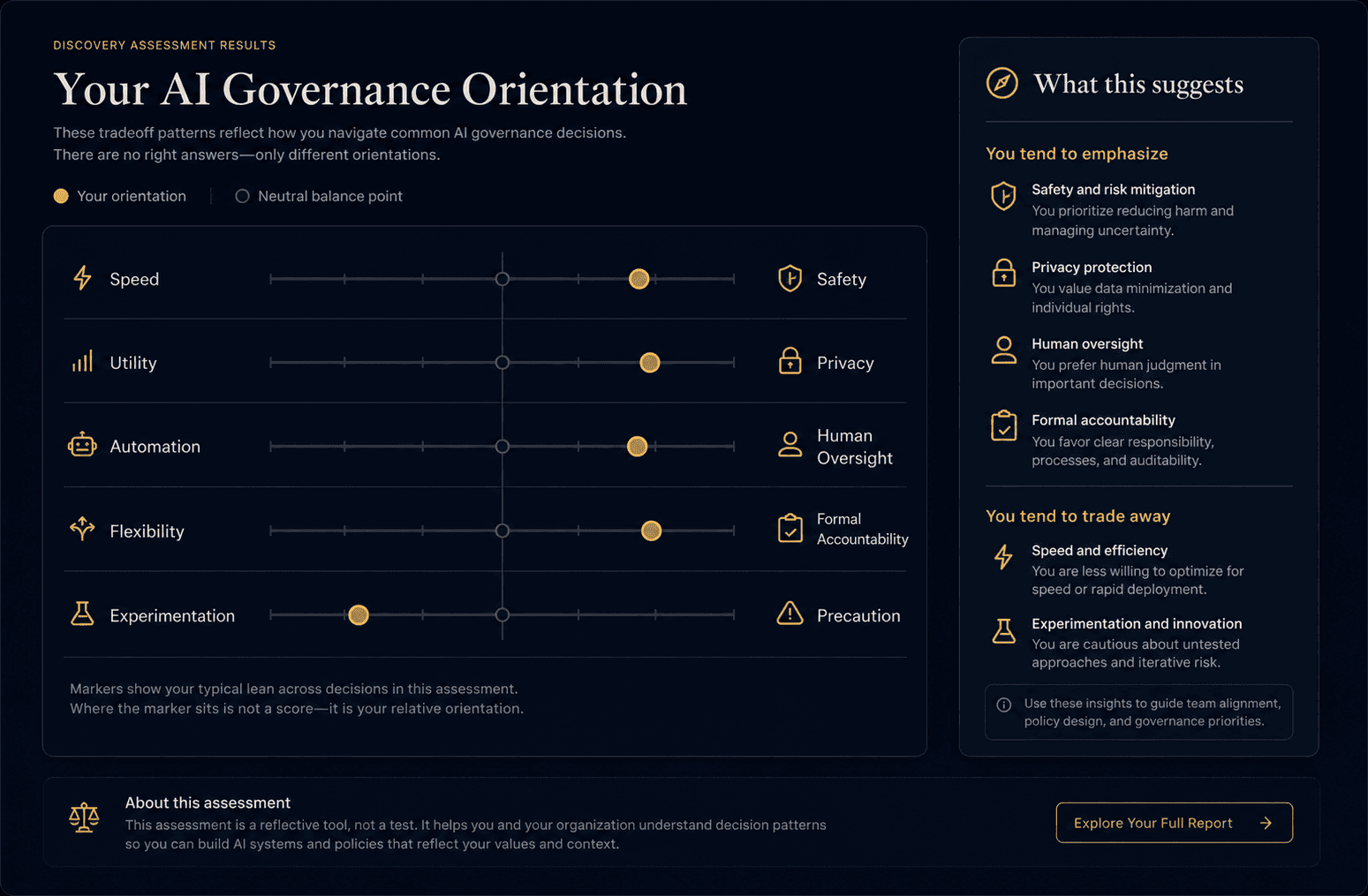
Discovery Assessment
Participants make structured choices across real AI tradeoffs. The platform uses fixed, expert-authored scoring to surface where a cohort may underweight privacy, fairness, safety, transparency, accountability, autonomy, or oversight.
What leaders get
Assessment data is valuable because it shows where policy needs stronger language, where training should focus, and where governance controls need to be clearer.
01
AI ethics readiness and fluency indicators
02
Cohort alignment, disagreement, and fracture zones
03
Governance risks where participants may underweight privacy, fairness, safety, oversight, or accountability
04
Policy language that responds to risk patterns rather than ratifying participant preferences
05
Co-branded reports, certificates, and benchmarking data for institutional programs
AI Policy Generator
The draft is shaped by cohort assessment patterns, governance risk findings, selected frameworks, and Policy Context answers about tools, departments, workflows, data types, approval paths, ownership, incidents, and review cadence.
Privacy, human oversight, documentation, appeal, fairness, security, and accountability requirements remain active.
The policy focuses on approval workflows, data handling, restricted uses, escalation paths, training, enforcement, and review triggers.
How it becomes policy
01
Create a cohort and invite participants
02
Run the Discovery Assessment before or after training
03
Generate an anonymized organization report
04
Add Policy Context about tools, departments, data, workflows, owners, and review cadence
05
Generate a first draft policy with required safety floors preserved
Built for institutions
Use it for faculty development, workforce programs, institutional pilots, safety readiness, policy creation, and co-branded reports that show measurable progress.